

Managed SASE is the delivery of a converged network and security architecture as a cloud-delivered service rather than a one-time deployment, and it’s moved from an emerging category to a mainstream buying decision. Secure Access Service Edge brings together the network and security functions that used to require separate products: Zero Trust Network Access, Secure Web Gateway, Cloud Access Security Broker, Firewall-as-a-Service, and SD-WAN, brought together under unified policy enforcement and delivered from the cloud.
Most organisations evaluating managed SASE services will speak to partners carrying five or six vendors in their portfolio. That’s often presented as flexibility: whatever platform suits your environment, we can deliver it. But what it doesn’t answer is the question of depth.
Carrying several SASE vendors is a commercial decision but if you ask how many certified engineers a partner has on any single platform, what the post-deployment support model looks like, and whether the team that runs the initial design is the same team managing security policies twelve months later. Then the answer may surprise you.
Managed SASE is not a product you configure and leave running. The architecture requires ongoing tuning, policy development, and operational discipline to deliver what it was designed for. A deployment that stalls at go-live, or that runs on its initial configuration without the depth to evolve alongside the business, has not failed because the platform was wrong. The platform is rarely the problem. The depth of the partner operating it is what determines whether the investment delivers.
What a SASE MSSP specialisation actually requires
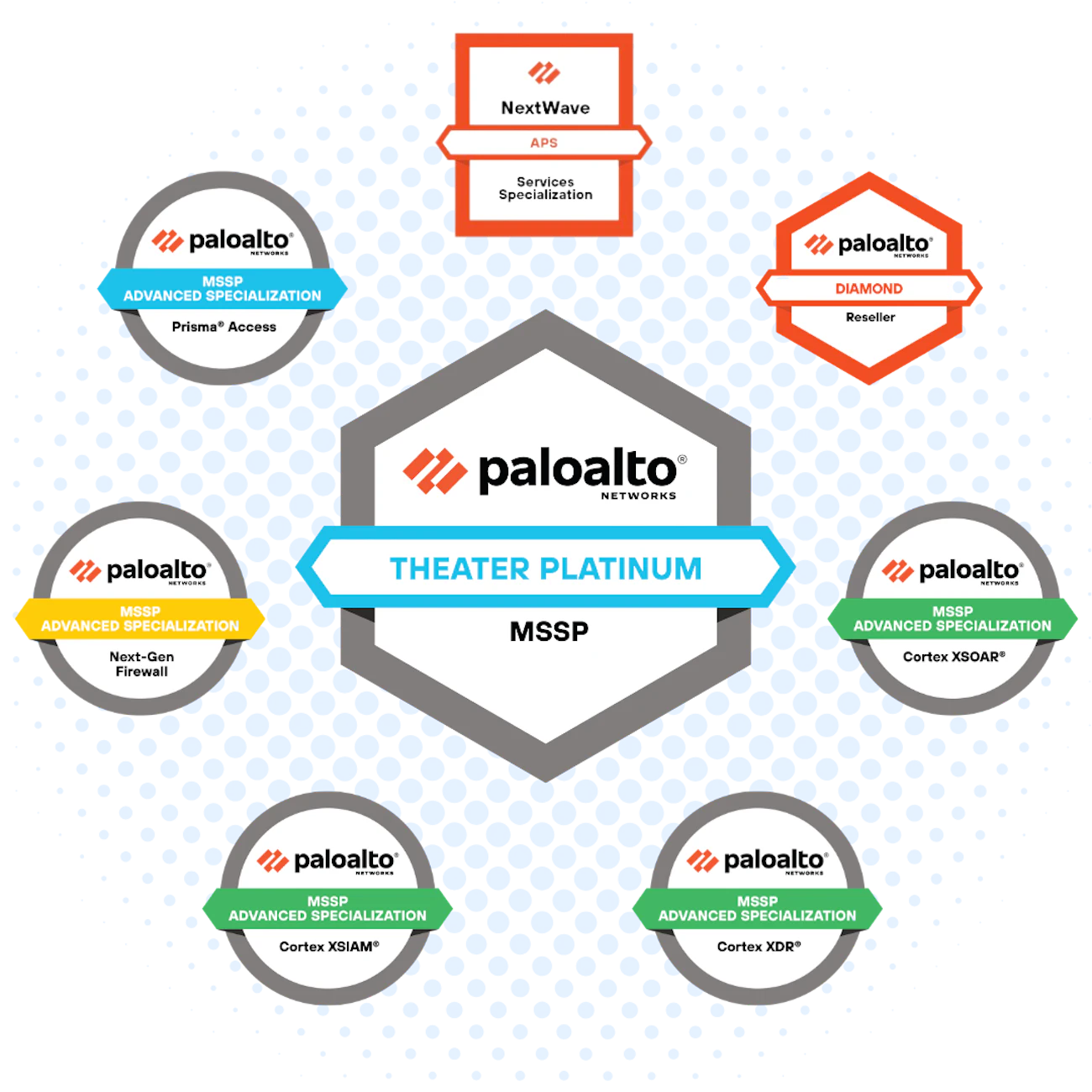
Palo Alto Networks’ SASE MSSP Specialisation requires every role in the delivery team to hold current Palo Alto technical certifications in Prisma Access and the wider SASE stack: sales consultants, network security professionals, and post-sales Security Service Edge engineers and analysts. Those certifications have to be maintained and the investment in keeping people technically current is an ongoing commitment to staying operationally sharp at the level Palo Alto Networks requires of its most trusted delivery partners.
That structure exists because Palo Alto Networks draws a clear line between partners who position the platform and partners who can genuinely design, deploy, and operate it at scale. The credentials represent a deliberate choice to build certified depth on the Palo Alto platform rather than spread investment across a wider set of vendors.
What the Centre of Excellence model means in practice
Credentials listed on a partner profile are only meaningful if they correspond to something real in delivery. For Nomios, the Centre of Excellence model is where that shines through.
The engineering and consultancy teams working on a Prisma Access design are in Palo Alto Networks environments every day. The architectural thinking behind any design comes from people whose daily operational reality is running Prisma Access and Cortex in production. The 24/7 UK-based SOC handles continuous threat detection, incident response, and policy enforcement across regulated and high-assurance sectors. This means the operational model described in the proposal is the one that you get and not a version of it staffed by a different team.
For anyone evaluating a Palo Alto SASE partner, that gap between who presents the design and who operates it afterwards is worth understanding before the engagement begins and it’s unfortunately where a lot of post-deployment disappointment originates.

Where SASE deployments stall
The failure patterns in SASE migrations are well understood. Applications hardcoded to trust a specific certificate will break the moment SSL inspection is introduced, often mid-cutover and without warning. Legacy VPN dependencies that were never documented surface at the worst possible time. And across a hybrid workforce, unmanaged devices and contractor access rarely map cleanly onto the Zero Trust policy model the architecture is built on.
The temptation to treat the whole thing as a lift-and-shift exercise is understandable, but SASE is a genuine architectural shift, not a re-skinned version of what came before.
SD-WAN is where a significant number of deployments can stall. Most SASE conversations start with security: SSE, zero trust, browser access. That’s where attention naturally falls, but without SD-WAN you’re only getting half the picture. Network connectivity and security need to converge for the platform to deliver on its promise, and when the network half is treated as secondary, the architecture struggles under real-world operating conditions.
None of these are platform problems. They are delivery problems, and they are far easier to solve at the design stage than after go-live.
Nomios's approach starts with assessment, specifically looking at identity posture, access gaps, and policy maturity. From there, deployment is staged with rollback available at each phase, protecting user experience throughout rather than treating it as an afterthought.
The post-deployment gap
Sustaining and improving that deployment over time is where the managed service model earns its value. SASE requires ongoing policy tuning, regular posture reviews, and continuous alignment between the security architecture and how the business operates. As SaaS access changes, cloud environments grow and the threat landscape shifts, a deployment left on its initial configuration depreciates.
Organisations that have inherited a SASE deployment from a previous provider often find exactly that: a platform running on its original settings, with no structured process for improvement and nobody accountable for making it better.
Quarterly optimisation reports, a named point of contact for ongoing service improvement, and a risk register tracking outstanding gaps are what a managed service should include as standard.
The SASE Advantage
If you’re scoping a SASE design, mid-way through an evaluation, or reassessing a deployment that has underdelivered, The SASE Advantage whitepaper sets out exactly how a certified, managed approach to Prisma Access is architected, sequenced, and operated. It’s a practical guide to what good looks like, written for the people who have to make the decision and live with it.