
| Threat | Urgent and brought-forward firewall security releases, plus PHP2Shell (CVE-2026-109618, CVE-2026-109619) in firewall web interfaces |
| Severity | High. Vendor ratings range from High to Critical (CVSS up to 9.8) |
| Status | Fixes available from all five vendors; remaining Palo Alto hotfixes estimated by 30 October. PHP2Shell is confirmed exploited (CISA, 26 October), but no exploitation of these firewall issues is reported |
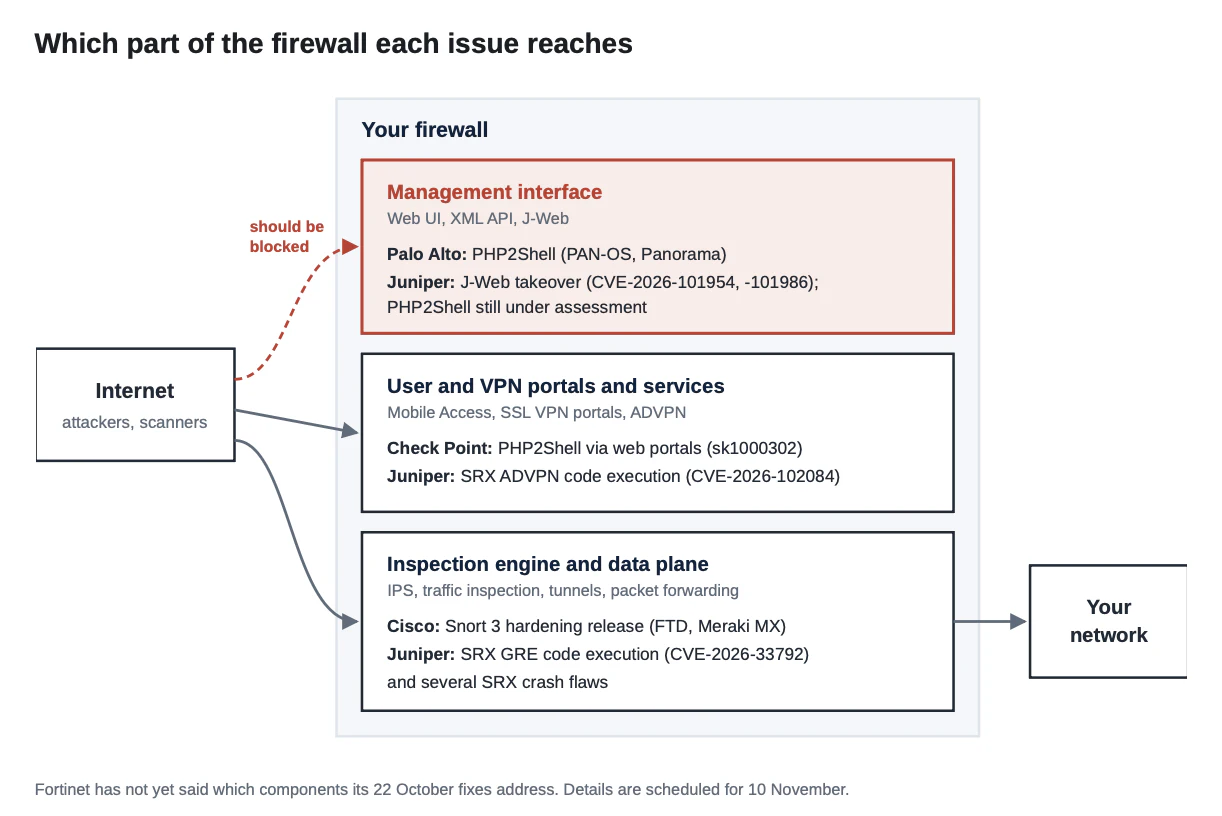
| Exposure | Internet-reachable management interfaces, user and VPN portals, and inspection engines |
| Priority | Confirm your version, upgrade as a priority change, take management off the internet |
What has happened
Fixes are arriving before the attacks
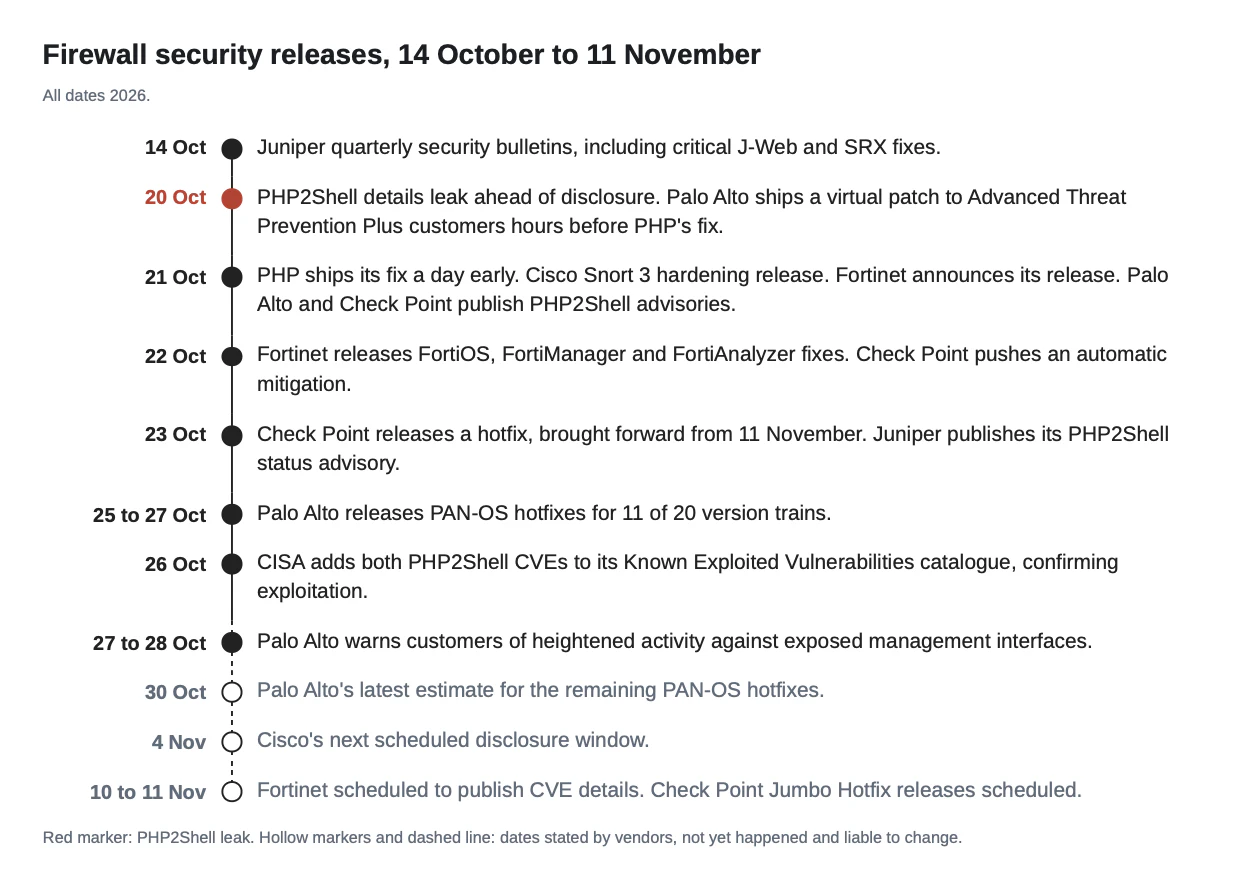
In the past two weeks every major firewall vendor has released urgent fixes, and several have shortened their usual timelines. In most cases the vendor says it is not aware of exploitation. They are moving early anyway, for three reasons.
- AI is finding flaws in bulk. Fortinet says its 22 October release fixes critical and high-severity flaws uncovered with frontier AI testing. Cisco says its 21 October Snort 3 hardening release came from internal testing that included frontier AI models, and it now groups such findings into hardening releases published twice a month on a fixed schedule.
- The gap between patch and exploit is shrinking. Fortinet is withholding CVE details until 10 November because AI tools can help attackers compare patched and unpatched code and build a working exploit in hours or days rather than weeks.
- Details are escaping early. Details of PHP2Shell, two critical flaws in the PHP engine, leaked on 20 October ahead of coordinated disclosure. PHP shipped its fix a day early, and firewall vendors that build PHP into their management or portal interfaces followed within days.

What the world is seeing
PHP2Shell reaches firewalls
PHP is built into the web interfaces of several firewall platforms, so PHP2Shell reaches devices that most people would not think of as web servers.
| Vendor | PHP2Shell status on 28 October |
| Palo Alto Networks | PAN-OS and Panorama management web interface affected. Hotfixes rolling out, remainder estimated by 30 October |
| Check Point | Gateways with web portals enabled affected. Hotfix released 23 October |
| HPE Juniper Networking | J-Web uses PHP. Whether it is affected is not yet confirmed |
| Fortinet | FortiOS, FortiManager and FortiAnalyzer confirmed not affected |
| Cisco | Secure Firewall (ASA, FTD) and Meraki confirmed not affected |
No exploitation of these firewall issues. None of the five vendors reports malicious exploitation of the issues in this bulletin. Palo Alto says it is not aware of exploitation of PHP2Shell against its products and Cisco says its October release is not known to be exploited. No exploitation has been reported for Fortinet's release or Juniper's October bulletins.
Palo Alto is warning of activity. This week Palo Alto Networks told customers it is aware of "heightened threat actor activity targeting internet exposed management interfaces" of PAN-OS firewalls and Panorama, and urged them to apply its management access best practices immediately.
PHP2Shell is being attempted at scale. Check Point Research reports exploitation attempts against 10 per cent of organisations worldwide since the leak, rising to 14 per cent in Europe, 12 per cent in the UK and 15 per cent in the Netherlands. It says attack traffic grew from thousands to millions of attempts after disclosure, and Zscaler ThreatLabz saw attempts within 48 hours. These are attempts, not confirmed compromises.
Most public exploit code does not work yet. VulnCheck, reviewing dozens of public PHP2Shell proofs of concept, says very few use the right mechanism and none defeats memory randomisation on x86-64 systems on its own. However, working exploits are in use: CISA added both PHP2Shell CVEs to its Known Exploited Vulnerabilities catalogue on 26 October, confirming exploitation in the wild. Expect noisy logs, where a flood of attempts says little about whether a given device is at risk, but do not dismiss them.
Exploits tend to follow disclosure. Fortinet is scheduled to publish its details on 10 November and Cisco's next disclosure window is 4 November, though vendors have been moving dates at short notice. Earlier this year attackers exploited firewall flaws after they were disclosed, including Cisco's ASA and FTD remote access VPN flaw (CVE-2026-20349) in August, two Firewall Management Center flaws fixed in Cisco's September hardening release, and Check Point's Security Management flaw CVE-2026-93616, added to CISA's Known Exploited Vulnerabilities catalogue on 22 September.
Severity ratings differ. PHP rates PHP2Shell 9.2 (CVSS v4.0). Palo Alto rates its own exposure High at 8.7, falling to 7.1 when management access is limited to a jump host. The difference reflects how exposed the interface is, not doubt about the flaw.

Actions for every customer
These steps apply whichever firewall you run. Your vendor's section gives the fixed releases and any vendor-specific steps.
Confirm what you run
- Check the version every device actually reports, including HA peers, standby and DR units, and management servers such as Panorama, Firewall Management Center, FortiManager or Check Point management. Use the device's own version output, not a change record.
Take management off the internet now
- Allow the web interface, API and SSH only from a jump host or a dedicated management network. Check data-plane interfaces that have management services enabled, because they expose the same service.
Upgrade as a priority change
- Not at the next routine maintenance window. Where your vendor requires it, upgrade the management server before the firewalls it manages.
Use interim protection where a fix is not yet available
- Vendor automatic mitigations, IPS or threat signatures, and switching off portals or services you do not use.
Check exposed devices for signs of compromise
- Before and after upgrading: administrator logins from unfamiliar addresses, new accounts, unexpected configuration changes, unexplained reboots or process crashes, and connections from the firewall itself to unfamiliar hosts. If you find any, contact the Nomios SOC before upgrading so evidence is preserved.
Expect noisy logs
- PHP2Shell scanning is producing large volumes of attempts and most public exploit code does not work. A flood of attempts does not on its own mean a device is at risk, and a quiet log does not mean it is safe.
Confirm with whoever manages your firewalls
- including Nomios, which of these releases have been applied and when the rest are scheduled.
Do not run public exploit code
- against your own devices.
Dates to plan around
These are the dates vendors have stated. They are liable to change: vendors have been moving dates at short notice in both directions. Check Point brought its fix forward by almost three weeks, while Palo Alto's 11.2.13-h4 hotfix, estimated for 27 October, had not been released by 28 October. Check your vendor's advisory before planning work around them.
| Date | Vendor | What the vendor has stated |
| 30 October | Palo Alto Networks | Latest estimated release date for the remaining PAN-OS hotfixes |
| 4 November | Cisco | Next scheduled security disclosure, with seven days' advance notice |
| 10 November | Fortinet | CVE identifiers, scores and detailed advisories scheduled for the 22 October release |
| 11 November | Check Point | Jumbo Hotfix releases scheduled to include the PHP2Shell fix |
Fortinet
At a glance
| Status | PATCH AVAILABLE Upgrade now, before details are published |
| What | Critical and high-severity "security hardening" release, 22 October 2026 |
| Affects | FortiOS 7.2, 7.4, 7.6 and 8.0 below the fixed releases, FortiManager and FortiAnalyzer |
| Exploitation | None reported. CVE details withheld until 10 November (scheduled, may change) |
| PHP2Shell | Not affected (FortiOS, FortiManager, FortiAnalyzer) |
What has changed
On 21 October Fortinet announced a security hardening release for FortiOS, FortiManager and FortiAnalyzer, published on 22 October after earlier updates for FortiMail and FortiAuthenticator. It fixes critical and high-severity flaws, and Fortinet asks customers to treat it as a priority change rather than routine maintenance.
Fortinet is holding back CVE identifiers, scores and per-issue detail until its Patch Tuesday, currently scheduled for 10 November, so attackers cannot use the advisories to reverse-engineer the fixes. Once the details are public, expect exploit development to follow quickly, so aim to finish upgrading before then.
| FortiOS branch | 8.0 | 7.6 | 7.4 | 7.2 |
| Fixed in | 8.0.2 or later | 7.6.8 or later | 7.4.13 or later | 7.2.14 or later |
What to do
- Run get system status on every FortiGate, including each HA member, and note the FortiOS version.
- Upgrade to the fixed release for your branch using Fortinet's upgrade path tool. Fortinet's usual order is FortiAnalyzer, then FortiManager, then FortiGates. FortiManager and FortiAnalyzer fixed releases are in Fortinet's announcement; FortiManager Cloud may need a manual update.
- 3 Until upgraded, make sure HTTPS and SSH administrative access is not enabled on internet-facing interfaces, and restrict administrators with trusted hosts. If a FortiGate runs a branch not listed, contact us before planning the upgrade.
Cisco
At a glance
| Status | PATCH AVAILABLE Upgrade FTD. Meraki MX updated automatically |
| What | Snort 3 Security Hardening Release: October 2026. Critical, CVSS 9.0, 21 October |
| Affects | FTD and Meraki MX, in any configuration. ASA is not affected |
| Exploitation | None known. Found internally, partly using frontier AI models |
| PHP2Shell | Secure Firewall (ASA, FTD) and Meraki not affected |
What has changed
Snort 3 is the inspection engine in FTD and Meraki MX. Cisco groups the flaws under CVE-2026-20043,-20236, -20291 and -20356; the worst are rated 9.0. There are no workarounds.
Meraki MX appliances online in Dashboard were updated automatically by 21 October. Snort 3 UTD on IOS XE routers also needs fixed images.
| FTD train | 7.0 and earlier | 7.2 | 7.4 | 7.6 | 7.7 | 10.0 | 10.1 |
| First fixed | 7.0.10 | 7.2.12 | 7.4.8 | 7.6.6 | 7.7.13 | 10.0.2 | 10.1.0 |
What to do
- Upgrade FTD to the first fixed release for your train. Upgrade the Firewall Management Center first if needed: it must run the same or a later version than the devices it manages.
- Confirm every Meraki MX is online and reporting to Dashboard.
- Subscribe to Cisco Security Notifications for advance notice of the next disclosure window, currently scheduled for 4 November.
Palo Alto Networks
At a glance
| Status | Rolling out: Restrict management access now; remaining hotfixes estimated by 30 October |
| What | PHP2Shell (CVE-2026-109618, CVE-2026-109619) in the management web interface. Advisory updated 27 October |
| Affects | PAN-OS 10.2 to 12.2 on PA-Series and VM-Series, and Panorama. No special configuration needed |
| Not affected | GlobalProtect, Clientless VPN, Captive Portal, Cloud NGFW and Prisma Access |
| Exploitation | Secure Firewall (ASA, FTD) and Meraki not affected |
What has changed
The flaw is reached through the management web interface (the HTTPS web UI and XML API) and through any data-plane interface with a management profile attached. Palo Alto rates its exposure High (CVSS-B 8.7), falling to 7.1 when management access is limited to a jump host. Its risk is highest when management can be reached from the internet.
This week Palo Alto emailed customers warning of "heightened threat actor activity targeting internet exposed management interfaces" and urged them to apply its management interface best practices immediately.
Node2Shell: Palo Alto says the same hotfixes also fix the Brotli flaw in Node.js covered in our Node2Shell bulletin of 26 October. The exception is 11.2.10-h16, which fixes PHP2Shell only; 11.2.10-h17 includes both fixes.
What to do
- Restrict management access now. Allow the HTTPS web UI and XML API only from trusted internal addresses or a jump host, and remove management profiles from internet-facing data-plane interfaces, following Palo Alto's best practice guide.
- Upgrade to the hotfix for your train (table on the next page) as soon as it is released, or to a later released hotfix on the same major version. Upgrade Panorama too; it must run the same or a later version than the firewalls it manages.
- Threat Prevention customers: enable Threat ID 543004 and the related IDs in the advisory (content version 9162 or later). They only protect management traffic that is routed through a data-plane interface, decrypted and inspected, so they do not replace restricting access. Advanced Threat Prevention Plus customers on 12.2.4 or later received coverage on 20 October.
- Review management logs for administrator logins and configuration changes from unexpected addresses since 20 October.
| If you run | Upgrade to | Status on 28 October |
| 12.2.0 to 12.2.4-h* | 12.2.4-h1 | RELEASED |
| 12.1.8 to 12.1.10-h* | 12.1.10-h3 | ETA 30 OCT |
| 12.1.5 to 12.1.7-h* | 12.1.7-h11 | RELEASED |
| 12.1.2 to 12.1.4-h* | 12.1.4-h13 | ETA 29 OCT |
| 11.2.14 to 11.2.16-h* | 11.2.16-h1 | ETA 28 OCT |
| 11.2.11 to 11.2.13-h* | 11.2.13-h4 | PENDING ETA was 27 Oct |
| 11.2.8 to 11.2.10-h* | 11.2.10-h16 (see note) | RELEASED |
| 11.2.5 to 11.2.7-h* | 11.2.7-h23 | ETA 29 OCT |
| 11.2.0 to 11.2.4-h* | 11.2.4-h23 | ETA 30 OCT |
| 11.1.14 to 11.1.16-h* | 11.1.16-h4 | RELEASED |
| 11.1.11 to 11.1.13-h* | 11.1.13-h16 | RELEASED |
| 11.1.8 to 11.1.10-h* | 11.1.10-h36 | RELEASED |
| 11.1.7 to 11.1.7-h* | 11.1.7-h12 | ETA 30 OCT |
| 11.1.5 to 11.1.6-h* | 11.1.6-h40 | RELEASED |
| 11.1.0 to 11.1.4-h* | 11.1.4-h38 | RELEASED |
| 10.2.17 to 10.2.18-h* | 10.2.18-h13 | RELEASED |
| 10.2.14 to 10.2.16-h* | 10.2.16-h12 | RELEASED |
| 10.2.11 to 10.2.13-h* | 10.2.13-h27 | RELEASED |
| 10.2.8 to 10.2.10-h* | 10.2.10-h42 | ETA 29 OCT |
| 10.2.0 to 10.2.7-h* | 10.2.7-h39 | ETA 30 OCT |
ETAs are Palo Alto's estimates and liable to change; the 11.2.13-h4 date has already passed. Where your hotfix is still pending, the advisory also lists a later release on the same major version (for example 11.1.16-h4 or 10.2.18-h13, both released). Older, unsupported versions must move to a supported fixed version.
Check Point
At a glance
| Status | Hotfix available: Apply the hotfix now |
| What | PHP2Shell via gateway web portals (e.g. Mobile Access, SSL Network Extender)and Spark (sk1000302) |
| Brought forward | Planned for the 11 November Jumbo Hotfixes (still scheduled); hotfix released early, on 23 October |
| Exploitation | None reported against Check Point gateways. PHP2Shell itself is confirmed exploited (CISA KEV) |
What has changed
Check Point pushed an automatic mitigation through Automatic Updates by 22 October, released a hotfix in CPUSE on 23 October, and added a built-in IPS signature that protects R82.20 even with the IPS blade off. The hotfix needs a reboot; there is no Live Patch.
| Version | Action |
| R82.20 | No hotfix. Protected by the built-in IPS signature; keep Automatic Updates on |
| Other supported releases | Install the sk1000302 hotfix through CPUSE, then reboot |
| Spark (locally managed) | Use the R81.10.17 packages in sk1000302. End-of-support releases: upgrade |
What to do
- Confirm Automatic Updates are on and the latest IPS update is installed, so the mitigation and signature are in place.
- Remove any manual cp-httpd.conf mitigation first, as it can disrupt portals and Jumbo Hotfix installs, then install the hotfix and reboot.
- Confirm the older fixes above, restrict Gaia WebUI to management networks and disable unused portals.
HPE Juniper Networking
At a glance
| Status | Patch available PHP2Shell pending: Upgrade and restrict J-Web |
| What | October 2026 quarterly security bulletins, 14 October, including several CVSS 9.8 flaws |
| Exploitation | None reported |
| PHP2Shell | J-Web uses PHP; impact not yet confirmed (Juniper status advisory, 23 October) |
What has changed
The most important October fixes for SRX are below. Fixed releases differ by issue and train, so check each bulletin.
| CVE | Issue (and when it applies) |
| CVE-2026-101954 | Unauthenticated device takeover through J-Web (9.8) |
| CVE-2026-101986 | J-Web authentication bypass and privileged CGI execution (9.8) |
| CVE-2026-33792 | SRX code execution or DoS where GRE tunnels are configured (9.8) |
| CVE-2026-101950 | SRX packet forwarding crash where Secure Vector Routing is enabled (9.8) |
| CVE-2026-102084 | SRX code execution from a malformed peer message in ADVPN |
| CVE-2026-102078/82/83/86 | SRX crashes (DNS over TCP, TLS resumption, Web Filtering, SecIntel) |
What to do
- Disable J-Web if unused ( delete system services web-management ); otherwise allow it only from trusted management hosts, never on untrust zones.
- Run show version on every SRX, including both chassis cluster nodes, and upgrade to a release that fixes the October issues for your train.
- J-Web runs on PHP and its PHP2Shell status was still listed as under investigation at the last public update. Treat it as potentially exposed until Juniper's status advisory confirms otherwise.
Conclusion
Every major firewall vendor has shipped urgent or accelerated fixes in the past two weeks, and none of the issues in this bulletin is yet known to be exploited against firewalls. That window is closing: CISA has confirmed PHP2Shell is being exploited, Palo Alto is warning of activity against exposed management interfaces, and Fortinet's details are scheduled to go public on 10 November. Confirm your version, upgrade now and keep management interfaces off the internet.
Get in touch with our security experts
Our UK team is available for a quick call or video meeting. Let's connect and discuss your security challenges, dive into vendor comparison reports, or talk about your upcoming IT projects. We are here to help.